
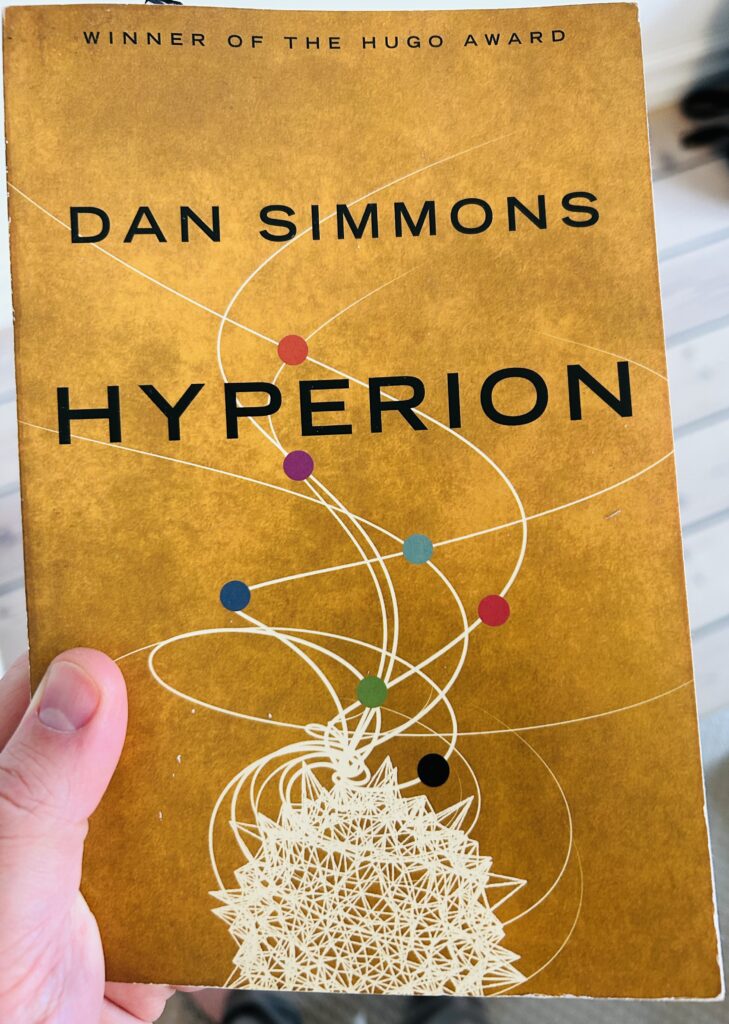
🚀 Warp-speed summary (in 3 sentences)
- All major powers in the known galaxy – two blocs of waring humans and an AI contingency known as the TechnoCore – race to the off-beat world of Hyperion, in order to control a temporal disturbance called the ‘Time Tombs’.
- Seven wildly different characters – a priest, a soldier, a poet, a scientists, a religious zealot, a private detective and a diplomat – are selected to conduct a last pilgrimage to the tombs, each trying to understand why their own lives have been tied to Hyperion.
- The book explores multiple themes surrounding time travel, power and religion at both the personal and inter-galactic level.
📡 Discovery
- The book has been mentioned on multiple ‘best of lists’ on Reddit and I cannot remember which one finally convinced me it was worth a read.
👨🚀 Impressions
Hyperion is an abandoned poem by John Keats about the fall of the Titans following their losing war with the Olympians from 1820. Why am I telling you this? Because Hyperion — the book — is heavily inspired by the poem, with multiple references and quotes from it throughout, even including an AI modelled on John Keats himself.
The book follows seven ‘pilgrims’ who are heading to the little-understood Time Tombs on Hyperion, where time seems to move backwards. On their way there, each character tells their backstory, which is all connected to the planet. Like the Titans, each character is grappling with a loss of their primary agency and power in some way or another: the loss of one’s religion, family, code of honour, planet. The mysterious Hyperion offers hope for each. The only person who seems to gain authority is the drunk and ill-mouthed poet, who develops an obsession with — and draws his creativity from — the murderous Shrike. “To be a true poet is to become God”, utters the Poet at some point, and one wonders whether he created the creature somehow.
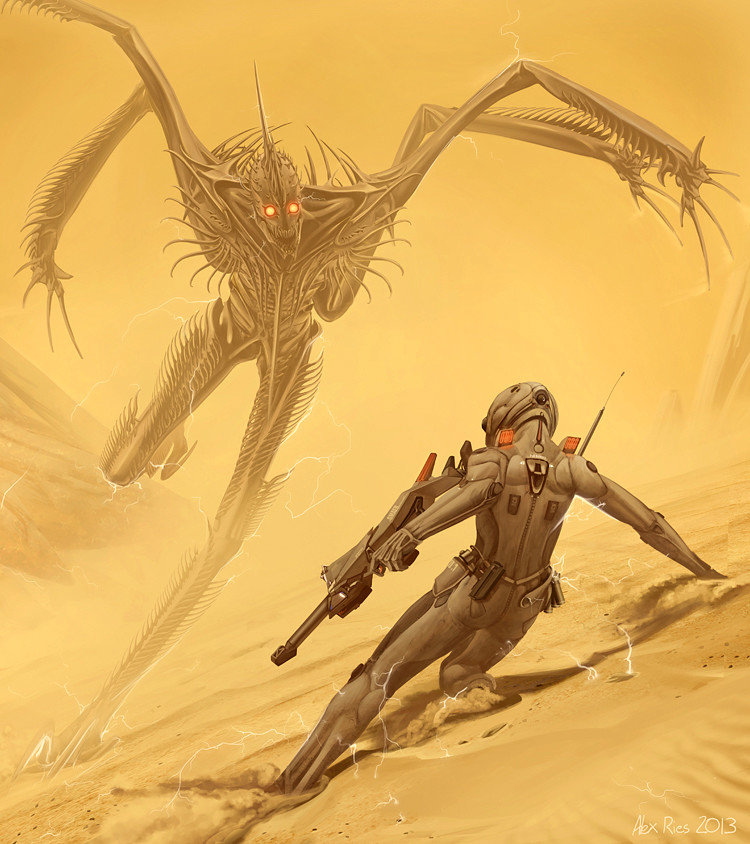
The Shrike as imagined by Alex Ries, The Lord and the Colonel, 2013.
The Shrike is a mysterious creature that can control time and — for unclear reasons — kill humans wherever it seems to meet them. 3 meters tall, four-armed, and equipped with blade-like fingers, it blinks in and out of existence, slowly increasing its terror regime to more and more of Hyperion, threatening the rest of the human civilisation known as the Hegemony. The Shrike has spawned a cult, which plays a powerful role throughout the Hegemony and is pulling strings in order to organise the pilgrimage. As the book develops, it’s hinted that the Shrike is a weapon sent backwards through time, but it’s unclear by whom or for what purpose.
Through each of the pilgrims’ stories, a complex web of intrigue is developed involving war between two human factions — the Hegemony, which draws its power from so-called farcasters, teleports between planets — and the Ousters, a species of humans developing into a true space-faring race by changing their own biology. Connected with both, indeed enabling and probably manipulating them, is the AI network known as the TechnoCore, which is working on developing a form of ‘ultimate intelligence’, with perfect predictive powers. For all factions, Hyperion poses a problem.
The book by Dan Simmons — written in 1989 — holds up well and explores a number of complex ideas, describes a vast universe, and has a very long list of interesting sci-fi concepts. Time is a major theme — it’s used as a weapon — but also works to connect characters as they travel back and forth, at different time-scales, or even stop time completely. Religion also plays a big role across the stories, with at least some of the characters coming down against a central tenet of early religious beliefs: obedience (“He had come to a single, unshakable conclusion: any allegiance to a deity or concept or universal principle which put obedience above decent behaviour toward an innocent human being was evil”). Somewhat similarly, none of the ‘pilgrims’ seem to really believe in the Church of the Shrike, which is organising the pilgrimage they are participating in, but simply use it for an end (which is, also, not particularly religious, in a Kierkegaardian sense at least).
This is contrasted with humans’ own use of and power over ‘technology’ in the book, which has become sentient. Either they trust it blindly (nobody really knows how their farcaster technology works, and they are wholly dependent on the TechnoCore to keep things running); or expect it to obediently do whatever they ask of it (such as the androids, which have been used to colonise and prepare Hyperion for human settlement).
I find this one of the most interesting ideas in the book: our complex relationship between humans and technology, who has power over whom, and the book’s visions of how this will play out. To me there seems to be a clear warning from Simmons here, which is a lot more complex and interestingly evolved than any typical “AI tries to destroy humanity” trope. Despite the violence of the book, the prominent role of the romantic poet Keats throughout the story perhaps points to a certain humanistic moral: if we don’t want to adhere to Gods ourselves, perhaps it’s best we try not to be Titans towards others.
This is book one of four, and I’m keen to see if the many storylines developed in this first volume can be tied together.
🦾 Top three moments
- The scholars story about trying to save his daughter.
- The poet’s tale start with the following: “In the beginning was the Word. Then came the fucking word processor. Then came the thought processor. Then came the death of literature. And so it goes.”
- The Shrike, of course, as a truly menacing creature.
⭐ Rating
🪐🪐🪐🪐: four mysterious planets out of five.
