
🚀 Warp-speed summary (in 3 sentences)
- Red and Blue are opposing agents, opposing beings even, fighting a war across time.
- Through elaborate schemes they constantly inhibit each other’s eon-long plans, but also exchange notes.
- What starts as a psych-op or way to incriminate the enemy develops into a romance.
📡 Discovery
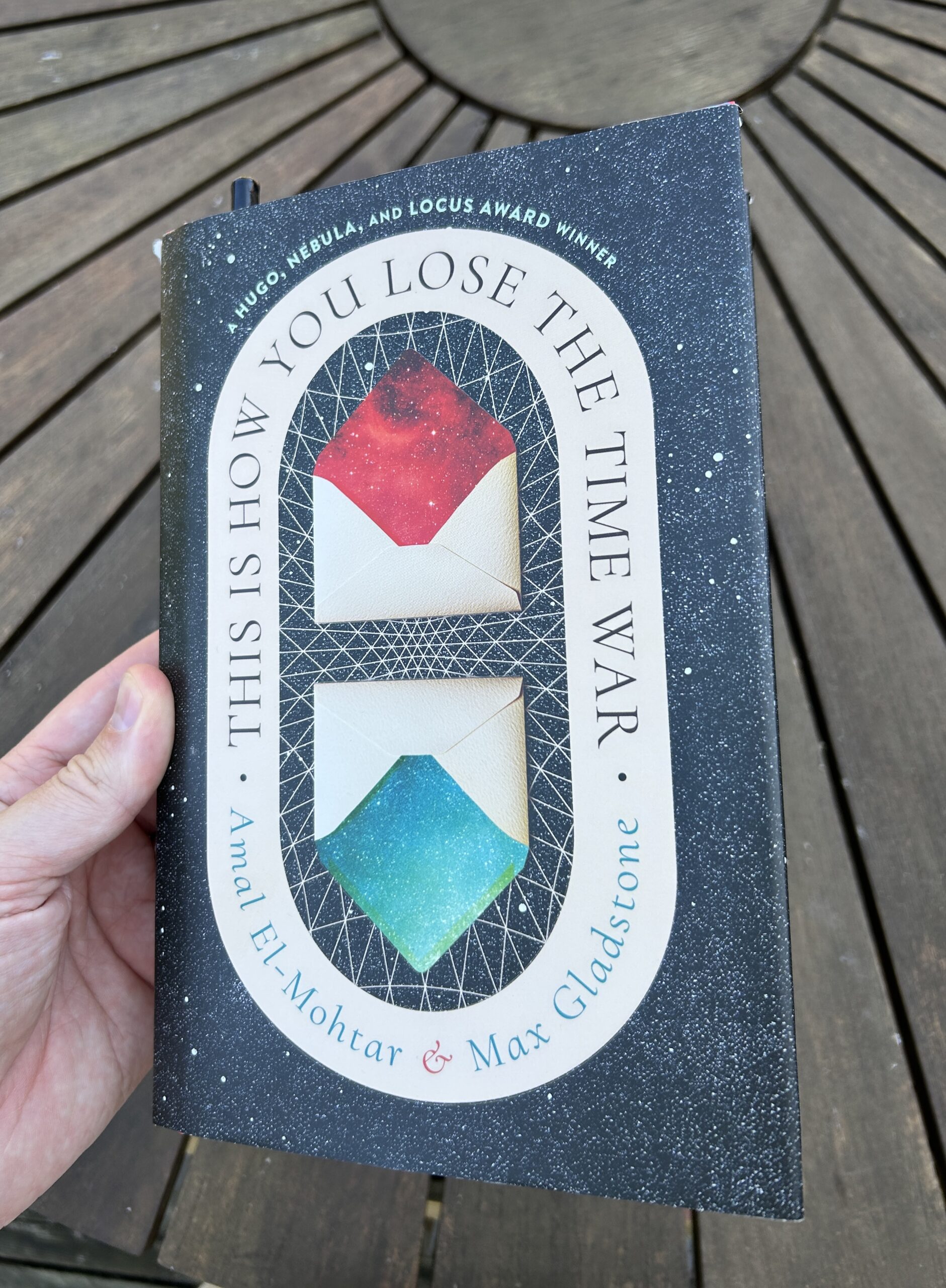
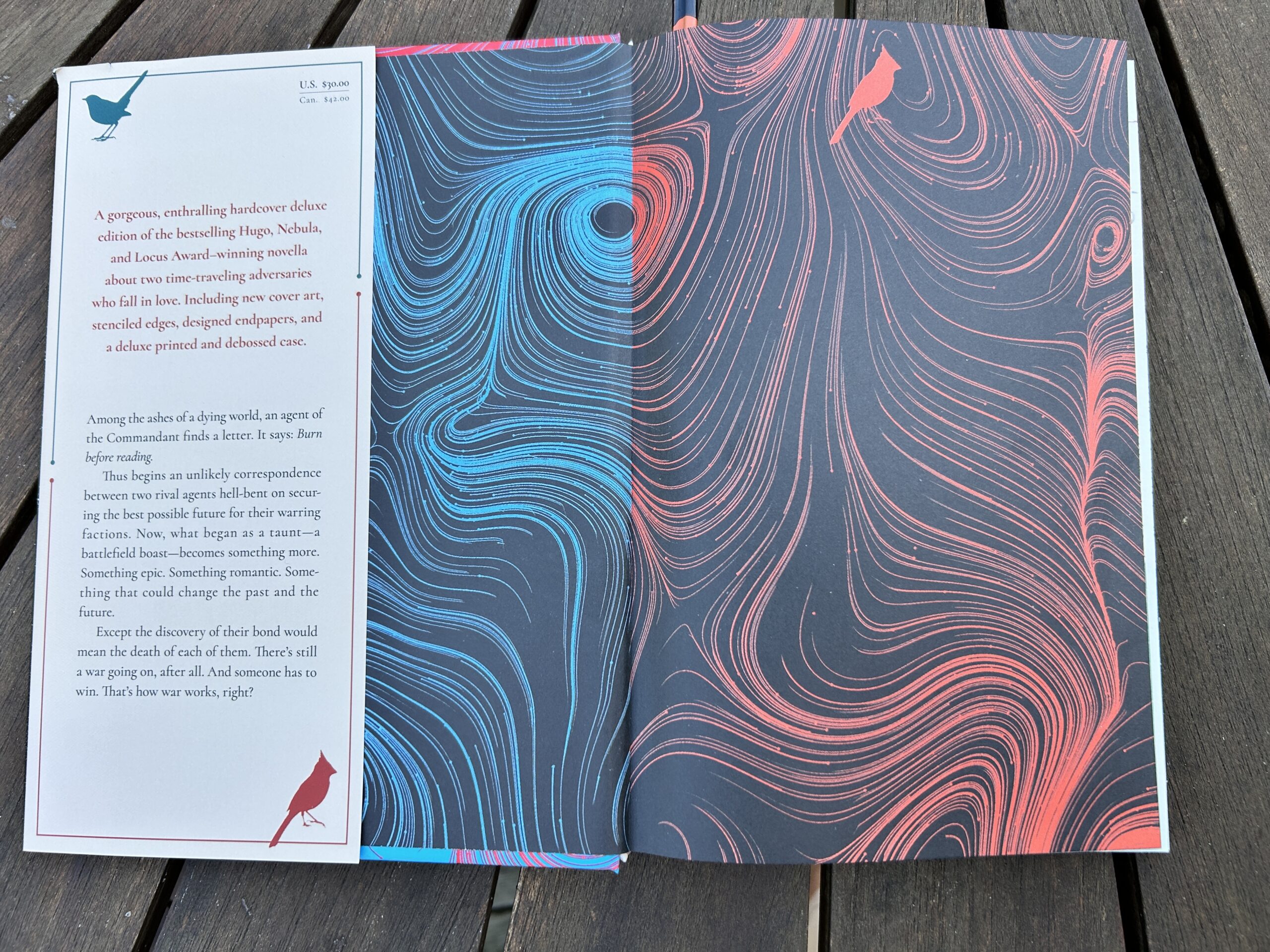
- Found it in the sci-fi section of a book shop in Champaign-Urbana, Illinois and was impressed by the cover and book design.
👨🚀 Impressions
Imagine, if you can, being a cyborg sent from the future to destroy an empire – not because the people in it did anything in particular, other than being needed by the other side some time in the future. Just as you have succeeded in an elaborate scheme which has killed millions of beings, you notice that the moon has not disintegrated like it should, some space-ships were not utterly destroyed: the other side did something to lessen your mass annihilation. This is a problem: “One spared life might be worth more to the other side than all the blood that stained Red’s hands today”. Wars in time “are dense with causes and effects, calculations and strange attractors […]”. None can, or should, survive, as they could end up off-setting the whole elaborate plan, in some annoying butterfly-effect.
This book is not about war as a non-linear dynamic problem or how chaos theory might be used as a weapon. It is also not concerned with the morality of killing off whole time-lines, worlds or people. It’s a book about what love means, and how romance can bloom in difficult conditions. But it is a love-story nonetheless between two mass-murderers, and when killing and murdering become part of one’s love-acts, it is hard not to think of this as a surrealistic travel through the twisted minds of war-loving fanatics.
Back to the story: in the less-than-complete destruction expected, cyborg Red finds a letter from the Garden agent Blue, mocking her. Blue is the opposite of Red, a grown agent, attacking her opponent in more elaborate and slow ways: is the letter just a way to seed doubt in Red’s loyalty? From then on the book settles into a back and forth between the two, with operations inhibited in an obscure way followed by a hidden letter from the opposing side.
The short stories of different battles are clever, as is the book’s description of the warring sides and their backstories. There’s a willingness to incorporate bizarre and weird concepts into the story, which are all well written. However, the main development happens in the letters, and as a reader one is never really in doubt what the outcome will be. I was missing some opposition, some challenge – some doubt in the other’s intention. When it finally comes in the end, the book shines.
The love that develops is also purely platonic. Red and Blue rarely meet, touch or interact through actions that are not superseded by some extremely violent destruction. Actually, their primary bonding seems to be through an admiration of the other’s ‘work’. Honestly, I found this somewhat poor – the physical side of love does play a role I would argue, but is neglected here.
In the end, the most serious act of love depicted in the book turns out to be trusting the other, and that moral is hard to argue against.
🦾 Top three moments
- The weirdness of the book, especially the constant short scenes in which Red and Blue find themselves, are memorable.
- The final act of our protagonists.
- The back-story of Red and Blue, which is slowly rolled out through the book.
⭐ Rating
💌💌💌: 3 out of 5 love-letters.
